Serengeti
A million wildebeest… each one driven by the same ancient rhythm, fulfilling its instinctive role in the inescapable cycle of life: a frenzied three-week bout of territorial conquests and mating; survival of the fittest as 40km (25 mile) long columns plunge through crocodile-infested waters on the annual exodus north; replenishing the species in a brief population explosion that produces more than 8,000 calves daily before the 1,000 km (600 mile) pilgrimage begins again.
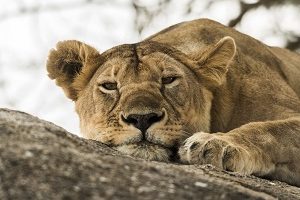
Tanzania’s oldest and most popular national park, the Serengeti is famed for its annual migration, when some six million hooves pound the open plains, as more than 200,000 zebra and 300,000 Thomson’s gazelle join the wildebeest’s trek for fresh grazing. Yet even when the migration is quiet, the Serengeti offers arguably the best game viewing in Africa: great herds of buffalo, smaller groups of elephant and giraffe, and thousands upon thousands of eland, topi, kongoni, impala and Grant’s gazelle. The spectacle of predator versus prey dominates Tanzania’s greatest park. Golden-maned lion prides feast on the abundance of plain grazers. Solitary leopards haunt the acacia trees lining the Seronera River, while a high density of cheetahs prowls the southeastern plains. Almost uniquely, all three African jackal species occur here, alongside the spotted hyena and a host of more elusive small predators, ranging from the insectivorous aardwolf to the beautiful serval cat.
There is more to a Serengeti Safari than large mammals. Gaudy agama lizards and rock hyraxes scuffle around the surfaces of the park’s isolated granite koppies. A full 100 varieties of dung beetle have been recorded, as have 500-plus bird species, ranging from the outsized ostrich and bizarre secretary bird of the open grassland, to the black eagles that soar effortlessly above the Lobo Hills
Popular the Serengeti might be, but it remains so vast that you may be the only human audience when a pride of lions masterminds a siege, focussed unswervingly on its next meal
The Serengeti combines superbly in a Northern Tanzanian Safari Circuit with Ngorongoro Crater, Lake Manyara National Park and Tarangire National Park. Excellellent connections by air with Zanzibar make it possible to round off a journey of a lifetime with a few days in Zanzibar.
The best time to visit the Serengeti if you wish to follow the wildebeest migration is December to July whilst predators will be more easily spotted in the drier month between June and October.