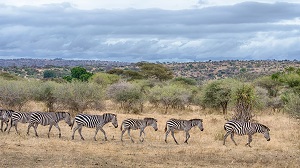
Tarangire National Park

The fierce sun sucks the moisture from the landscape, baking the earth a dusty red, the withered grass as brittle as straw. The Tarangire River has shrivelled to a shadow of its wet season self. Permanent water in the dry season ensures that Tarangire is teeming with wildlife.

A Tarangire Safari in the dry season can be very rewarding indeed in terms of wildlife sightings and the park is also scenically very attractive.

Herds of up to 300 elephants scratch the dry river bed for underground streams, while migratory wildebeest, zebra, buffalo, impala, gazelle, hartebeest and eland crowd the shrinking lagoons.
It’s the greatest concentration of wildlife in Tanzania outside the Serengeti ecosystem – a smorgasbord for predators – and the one place in Tanzania where dry-country antelope such as the stately fringe-eared oryx and peculiar long-necked gerenuk are regularly observed.

During the rainy season, the seasonal visitors scatter over a 20,000 sq km range until they exhaust the green plains and the river calls once more. But Tarangire’s mobs of elephant are easily encountered, wet or dry.

The swamps, tinged green year round, are the focus for 550 bird varieties, the most breeding species in one habitat anywhere in the world. 

Tarangire’s pythons climb trees, as do its lions and leopards, lounging in the branches where the fruit of the sausage tree disguises the twitch of a tail.

Tarangire National Park combines superbly in a Northern Tanzanian Safari Circuit with Ngorongoro Crater, Lake Manyara National Park and the Serengeti Game reserve. Excellellent connections by air with Zanzibar make it possible to round off a journey of a lifetime with a few days in Zanzibar.

The best time to visit Tarangire is in the dry season months between June and october during the wet season the animals are widely dispersed.